
Radon testing
Radon testing for North Georgia homes
You can’t see or smell radon, and a neighbor’s result can’t tell you yours. I place a continuous radon monitor in the home for at least 48 hours, then send you the result and explain what it means.
Buying a home? Add radon when you schedule your inspection


Why test
Should you test for radon in North Georgia? EPA says test every home.
Radon is a radioactive gas that comes naturally from the ground. It can get into a house through cracks and openings in the foundation and build up inside, and long-term exposure raises the risk of lung cancer. You can’t see it or smell it, but it’s easy to measure, and high levels can be fixed.
EPA recommends testing every home, whatever its zone or county, and that includes new homes. Locally, the numbers show why:
- In UGA Extension’s records, about one in three radon tests from Hall County homes came back at or above EPA’s action level of 4 pCi/L. Those are homes whose owners chose to test, not a random sample.
- Gwinnett is one of only four Georgia counties in EPA’s highest radon zone, Zone 1. Hall, Jackson, Barrow, Forsyth, Dawson and Lumpkin are in Zone 2.
Zones and county figures can’t tell you about one particular house, though. Only a test in that house can. And Georgia doesn’t require a radon test when a home is sold, so it’s up to you to ask for one.
From my tests
The house next door can’t tell you your number.
Radon can be very different from one house to the next, even on the same street. I remember one Gainesville house that came back far above EPA’s action level. About three months earlier I had tested the house next door, only 20 or 30 feet away, and that one was low.
Nobody expected it. The buyers used the result to negotiate with the seller for money toward a mitigation system. That’s why a neighbor’s result, a county map or an old test can’t tell you what’s in the house you’re buying.
How it works
How long does a radon test take? At least 48 hours.
- Closed house. From 12 hours before the test until it ends, windows and outside doors stay closed, fans that pull in outside air stay off, and the heat or air conditioning runs normally. Normal coming and going is fine. I’ll go over this with you when we set the date; if you’re buying, your agent can pass it on to whoever lives in the house.
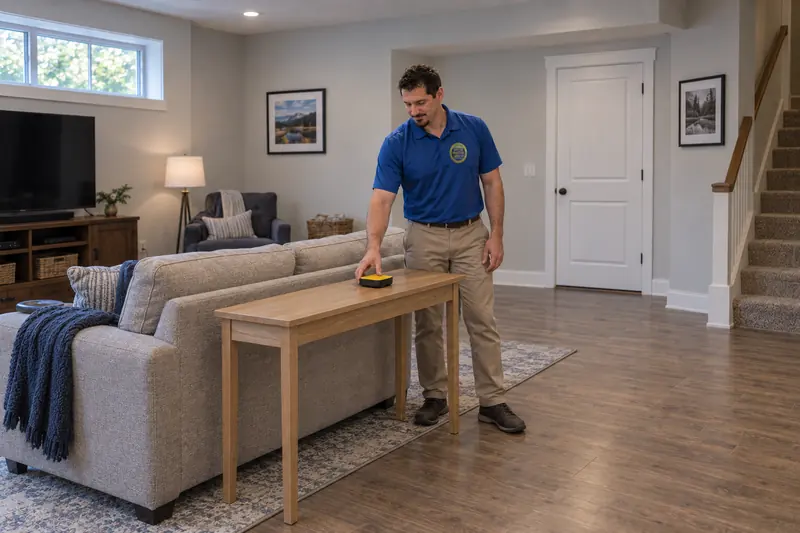
- Monitoring. I set up my monitor, an Airthings Corentium Pro, often during your home inspection visit. It’s a professional continuous radon monitor that runs on its own batteries, so it doesn’t need an outlet and keeps recording through a power outage. It goes in the lowest level you could live in, at least 20 inches off the floor and away from outside walls, windows and vents, and it takes a reading every hour for at least 48 hours. If anyone moves it, it logs that too.
- Pickup. After at least 48 hours, I collect the monitor.
- Your result. I send you the written result and explain what it means, and what to do if it’s high. Because the monitor records every hour, the result can show how the level changed during the test, not just one average.
Because the test needs at least two full days plus pickup, start it early in your due-diligence period. The inspection date and the date you need the result aren’t the same, so tell me both when you reach out.
I’m IAC2 Radon Certified: verify my listing. Want to know how the rest of the inspection works? Here’s what to expect →
“George did a radon inspection on my basement. … When the test was complete it was emailed to me so I had a copy. He was able to explain everything in detail and help me gain knowledge about what my next steps would need to be.”
Paige Cocco · Google review · Radon test on a basement Read the reviews on Google
Your result
What your radon result means.
Radon is measured in picocuries per liter (pCi/L). EPA recommends fixing a home at 4 pCi/L or higher, and suggests considering a fix between 2 and 4.
A high result is fixable. The usual fix is a vent pipe and fan that pull radon from under the house and vent it above the roof. A qualified mitigation contractor designs and installs it, the fan sits outside the living space, and a follow-up test confirms the system is working.
Buying? A high result is information to bring to your agent before your due-diligence deadline.
New homes & existing systems
A new house or a radon fan? Still test.
New homes can have radon too. EPA says every new home should be tested after you move in, even one built radon-resistant. And if a house already has a mitigation system, the pipe and fan tell you something was installed, not what the level is today.
Building new? See new construction inspections. Other tests worth knowing about: mold testing and a sewer scope.
Questions
Radon questions.
Is radon testing part of a standard home inspection?
No. It’s a separate test, but it’s easy to add: the monitor is often set up during your home inspection visit.
Can I get a radon test without a home inspection?
Text me the address and a couple of days that work for you, and I’ll tell you what I can arrange.
Can people stay in the house during the test?
Yes. Normal coming and going is fine. From 12 hours before the test until it ends, keep windows and outside doors closed and fans that pull in outside air off, run the heat or air conditioning normally, and leave the monitor where I put it.
Can you test a vacant house?
Yes. My monitor runs on its own batteries, so it doesn’t need an outlet. The house still needs the right conditions, though: for a short-term test, the national testing standard expects the heat or air conditioning to run normally for 12 hours before the test and all the way through it. If the utilities are off, tell me when you reach out, so they can be back on in time.
How many monitors do you use?
Usually one, in the lowest level you could live in. A large or spread-out lowest level, more than one heating and cooling system, or a mix of foundations (a basement plus a slab addition, say) can call for more than one test location, and I’ll tell you if your home is one of these.
Does Georgia require a radon test when you buy a house?
No. Georgia law doesn’t require radon testing in home sales, so it’s up to you to ask for it. EPA recommends testing every home.
Where do you test for radon?
Anywhere I inspect, within about an hour and a half of Flowery Branch: Gainesville and Hall County, Gwinnett, metro Atlanta and the North Georgia mountains. Find your town →
Next step
When do you need your radon test?
Buying a home? Add radon when you schedule your inspection
 Eyes open, not fingers crossed. — George
What happens next
Tell me the property address and when you need the results.
I confirm the date, the test timing and the price with you.
I run the radon test, send your results and explain what they mean.
You’ll know the price before you sign anything.