
Pool & spa inspections
Pool & spa inspections in North Georgia
A standard home inspection leaves the pool out. If the house you’re buying has a pool or a spa, I’ll look at what you can’t judge from the deck: the pump, filter and heater, the wiring and safety features, and whether the pool is losing water.
Buying a home? Add a pool and spa inspection when you schedule your inspection
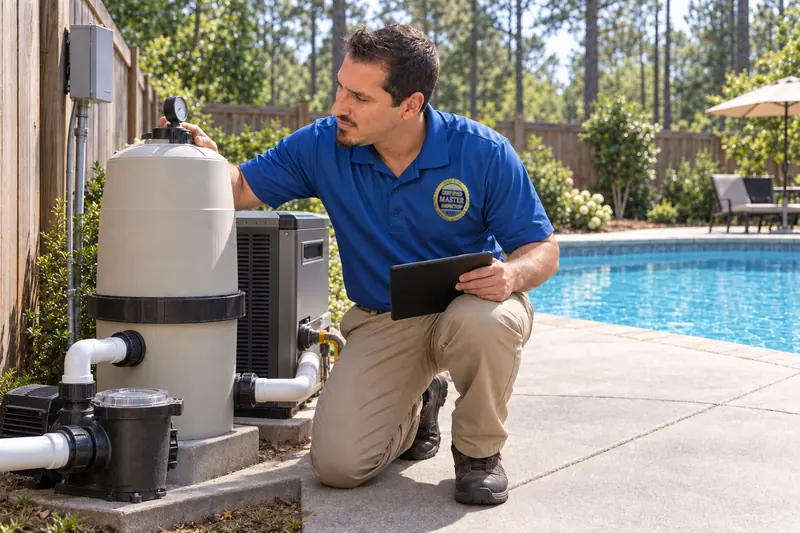



Why inspect it?
The pool isn’t part of a standard home inspection.
Home inspection standards leave pools and spas out. InterNACHI’s standards say a home inspector isn’t required to inspect them, so a pool and spa inspection is a separate add-on.
Pools live with constant moisture, chemicals and wear. Problems with the equipment, the wiring, the circulation and the safety features are common and easy to overlook, and most of them don’t show in the water. A pool inspection tells you what you’re buying while there’s still time to ask questions or negotiate.
You can add it to your home inspection, so it happens on the same visit, or book it on its own.
“George went the extra mile to ask me what I wanted him to look at and pay extra attention to. I told him that if we could take a closer look at the basement, HVAC, backside and backyard of our prospective home, then that would be fantastic.”
Riyan Imam · Google review · Home buyer Read the reviews on Google
What I check
What a pool and spa inspection covers.
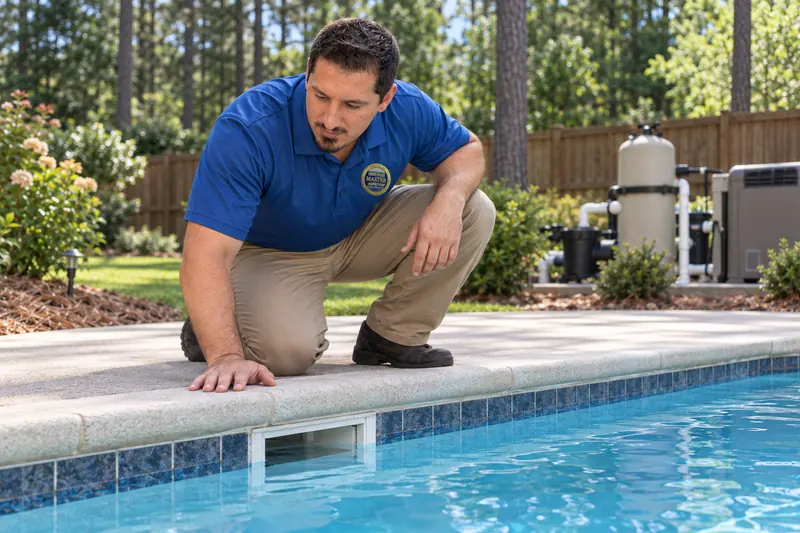
It’s a visual evaluation of the pool and spa parts that can be safely reached, following InterNACHI’s Pool and Spa Standards of Practice:
- The pool: the water level, the interior surface, tile and coping, steps, handrails and ladders, and the deck around it
- The equipment: the pump and motor, the filter, valves, the plumbing you can see, skimmers and drains, and the heater or heat pump, run with their normal controls when it’s safe to
- The electrical parts you can see: GFCI protection, the bonding wire on the pump motor, the pool lights, and the timers and controls
- The spa: the jets, air controls, suction fittings and spill-over edge
- Safety: the fence or barrier, the gates and any alarms, and whether the pool has a single blockable main drain, a potential entrapment hazard
What it doesn’t cover: water chemistry, finding where a leak is in the shell or in buried pipes, slides and diving boards, salt systems, automation and solar heating, or starting up anything that’s winterized or shut down. And it isn’t a code inspection. I report what I can see on the day, and I’ll tell you when a pool contractor, an electrician or a leak specialist should take a closer look.
Water-loss test
Is the pool losing water? A Leakalyzer test checks.
Every pool loses some water to evaporation. The question is whether it’s losing more. When the pool is open at its normal water level, I run a Leakalyzer test while I inspect the rest of the pool. It reads the water level to a ten-thousandth of an inch, usually for 10 to 20 minutes (longer on a windy day), and compares the change with an estimate of evaporation. It shows whether, during the test, the pool was losing water beyond evaporation, and roughly how much.
For the test, any automatic fill has to be off. It tells you whether, not where, and it can’t rule out every leak: if it shows a loss, a leak-detection specialist can find the source before you close, not after.
Safety
Fences, gates, drains and electricity.
If young children will be around the pool, the U.S. Consumer Product Safety Commission recommends layers of protection: a fence or barrier at least 4 feet high, gates that open outward and close and latch on their own, alarms on the doors that lead to the pool, and a safety cover. CPSC notes that most child pool drownings happen at a home, not at a public pool.
Georgia’s state pool code sets barrier rules for new pools, but a pool built legally under older rules can stay in use as long as it’s kept up and isn’t hazardous. So an older pool may not match today’s safety standards. Some local rules reach existing pools too: unincorporated Gwinnett County, for example, requires a fence or barrier at least 4 feet high around every pool.
Two more things I look at closely:
- Drain covers. When I can see them, I check for cracked, loose or missing covers; any of those is a stop-swimming problem until it’s repaired.
- Electricity near water. I test the GFCI protection I can reach and report missing bonding I can see. Confirming a pool’s whole bonding system takes an electrician’s testing, so for anything electrical I’ll point you to a licensed electrician who works on pools.
Questions
Pool and spa questions.
Does a regular home inspection include the pool?
No. Home inspection standards leave pools and spas out, so it’s a separate add-on. You can add it when you schedule your home inspection.
Can I get a pool inspection on its own?
Yes. I do pool and spa inspections on their own or with a home inspection. For one on its own, text or call me to set it up; the online scheduler is for home inspections.
Can you inspect a pool that’s closed for the winter?
Partly. I can still check what’s visible: the deck, the coping and any tile I can see, the equipment, the visible wiring, and the fence, gates and alarms. Winterized equipment isn’t restarted, though, so how the pump, heater and lights run, and whether the pool holds water, can’t be judged. Ask the seller for last season’s photos and service records, and talk with your agent about your options.
Do you test the water?
No. Water chemistry, clarity and algae are outside the inspection. A pool service company can test and balance the water.
Is the hot tub included?
A built-in spa is. A portable hot tub isn’t part of the pool and spa standard, but if it’s filled and running, I’ll look at it too: the controls, the jets, the cover and the electrical connection. Mention it when you reach out.
Will you tell me whether the pool is up to code?
No. A pool inspection isn’t a code inspection. I report the defects and safety concerns I can see on the day, and I’ll tell you when an electrician, a pool contractor or a leak specialist should take a closer look.
How much does a pool inspection cost?
It depends on the pool and the property. Text me the address and I’ll tell you, and you’ll know the price before you sign anything.
Where do you offer pool inspections?
Anywhere I inspect, within about an hour and a half of Flowery Branch, from Gainesville and Lake Lanier to Gwinnett and metro Atlanta. Adding it to a home inspection? Here’s what inspection day looks like. Find your town →
Sources
- InterNACHI: Pool and Spa Inspection Standards of Practice
- InterNACHI: Home Inspection Standards of Practice (pools and spas not included)
- Leak Tools (Anderson Manufacturing): the Leakalyzer water-loss sensor
- U.S. CPSC: pool or spa submersion report (2026)
- U.S. CPSC: Safety Barrier Guidelines for Residential Pools (Pub. 362)
- Georgia DCA: mandatory and permissive state codes (including the swimming pool code)
- Gwinnett County: common code violations (pool fences)
- U.S. CPSC: ways to protect yourself from shock or electrocution in pools and spas
Next step
When do you need your pool inspection?
Buying a home? Add a pool and spa inspection when you schedule your inspection
 Eyes open, not fingers crossed. — George
What happens next
Tell me the property address, when you need the inspection, and whether the pool is open.
I confirm the date, time and price with you.
I inspect the pool and spa myself and send you my findings.
You’ll know the price before you sign anything.