
Dahlonega · Lumpkin County · the mountains
Home inspector in Dahlonega & Lumpkin County
Buying in Dahlonega or up in the mountains? I’m George Karampoulis, a Certified Master Inspector based in Flowery Branch. I inspect homes in Dahlonega regularly, from in-town houses near the square to cabins on a ridge, and I do every inspection myself.
Prefer to call? (678) 941‑6781
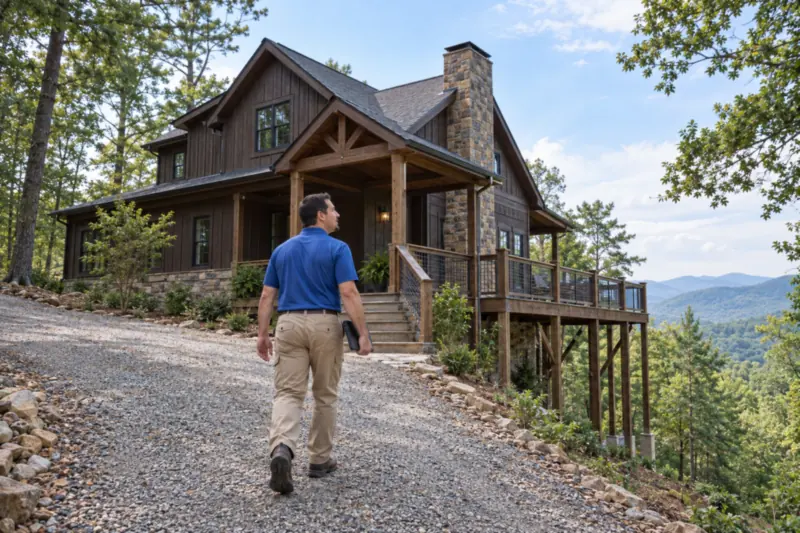


Dahlonega homes
In-town houses, cabins and new builds toward Dawsonville.
Dahlonega is the Lumpkin County seat, in the foothills of the Blue Ridge Mountains, and home to the University of North Georgia’s Dahlonega campus. The houses vary as much as the land does. Around the historic square, the city’s 2022 survey of its historic resources recorded homes from nineteenth-century house forms to bungalows and ranch houses. Out in the county there are mountain homes and cabins on wooded lots, and the county’s plan says most growth is in the south of the county, with the most requests for development permits between Dahlonega and Dawsonville.
Each calls for a slightly different look:
- An older in-town house: how it has aged, the crawl space, and signs that past repairs or additions weren’t done well.
- A cabin or log home: the log ends, the chinking and the finish, settling around doors and windows, and carpenter-bee holes or other insect damage I can see. Nobody can see inside a log, so I’ll tell you what the outside shows.
- A newer home toward Dawsonville: drainage and grading on a freshly built lot, and anything the builder should fix while the warranty lasts. New construction inspections, including the 11-month warranty inspection →
“George did excellent job inspecting our cabin in Helen. He was very informative and stayed in touch with me in entire process.”
Amruta Robledo · Google review · Bought a cabin in Helen Read the reviews on Google
Mountain lots
Steep lots, hillside decks and wood siding.
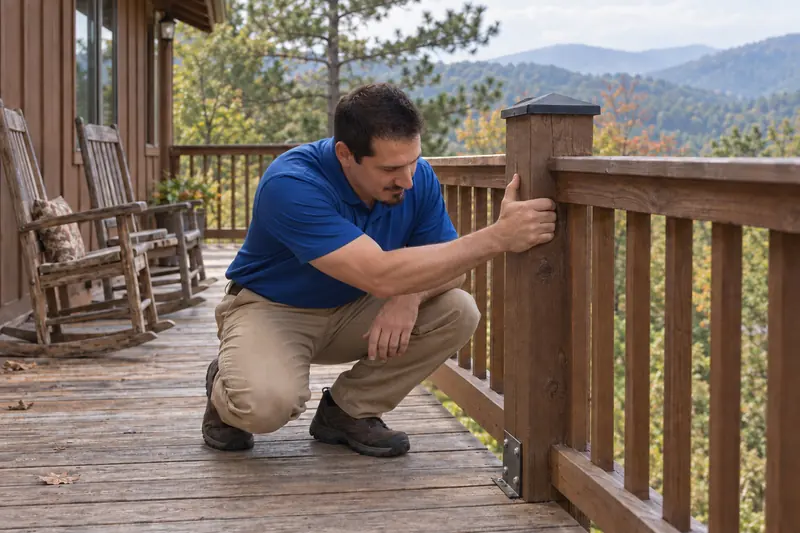
Mountain homes have a few things in common, and the same issues come up again and again:
- Grading and drainage. On a slope, runoff from uphill can reach the house. I look at how the grading, drainage and retaining walls may affect the house; soil stability and slope engineering are for a geotechnical engineer.
- Hillside decks. A deck on tall posts gets a hands-on check: the ledger where it attaches to the house and its flashing, where they can be seen, the posts and bracing, and the railings.
- Wood siding and trim. Carpenter bees go for cedar, cypress and pine, especially old, unpainted wood, and years of tunneling in the same boards can weaken them. Woodpeckers hunting the larvae can tear the siding open.
- Winter. A cabin that sits empty in cold weather is prone to frozen pipes. Georgia’s Environmental Protection Division advises keeping the heat at 55°F or higher when you’re away and protecting pipes in crawl spaces and attics.
- Fireplaces and fuel. A chimney camera can see inside the flue where a standard inspection can’t (it isn’t a Level 2 chimney inspection). I note where a propane tank sits, but the tank, the gas lines and any generator need their own specialists.
Buying a cabin? Tell me about the driveway and the deck when you reach out.
Well & septic
On a well and septic? Here’s who checks them.
Many Lumpkin County homes rely on a private well and a septic system. USGS figures suggest most county residents aren’t on a public water system, and the state’s regional water plan estimates that septic systems handle most of the county’s wastewater. I don’t test wells or inspect septic systems, so start these early:
- The septic record. Email Lumpkin County Environmental Health at lumpkineh@dph.ga.gov with the property address to request the septic permit record, and allow up to 48 hours. The same office takes applications to evaluate an existing system for a home sale, with the owner’s written permission.
- The tank itself. A septic contractor certified by the Georgia Department of Public Health can open and pump the tank and report on its condition.
- The well water. Lumpkin County Environmental Health tests well water for bacteria (it takes samples Monday to Wednesday, and a buyer needs the owner’s written permission to apply), and UGA Extension’s Dahlonega office sends samples to UGA’s lab for mineral, lead and other tests, with results in about 10 to 12 business days. If your lender wants particular tests, ask which ones. Water testing doesn’t evaluate the well’s pump, yield or reliability; a well contractor can.
During the inspection, I note whether the water supply looks public or private and report what I see of the plumbing, so you know what to follow up on.
Radon
Zone 2 on EPA’s map, but test anyway.
EPA puts Lumpkin County in radon Zone 2, a moderate-potential zone. Yet in UGA Extension’s records, more than a third of the Lumpkin County radon tests from 1990 to 2024 (211 of 588) came back at or above EPA’s action level of 4 pCi/L. Those tests were done by people who chose to test their homes, not a random sample, and only a test in your house can tell you your number. EPA recommends testing every home.
On a private well, UGA suggests testing the air first, and testing the water for radon if the air result is high.
A radon test runs at least 48 hours, so start it early in your due diligence. Radon testing →
Questions
Dahlonega & Lumpkin County questions.
Do you really come up to Dahlonega?
Yes, regularly. I inspect across Lumpkin County and into the mountains, from Dawsonville and Murrayville up to Cleveland, Helen and Clarkesville, and farther when the house is within about an hour and a half of Flowery Branch. It’s the same inspector and the same 24-hour report. Find your town →
Do you inspect log homes and cabins?
Yes. I check the log ends, the chinking, the finish and signs of settling, and I point out carpenter-bee holes and other insect damage I can see. No one can see inside a log, so rot hidden inside one is beyond any visual inspection.
Do you inspect the well and the septic system?
No. The county’s environmental health office, a certified septic contractor and UGA Extension’s water testing cover those; here’s how.
Planning to rent the cabin out?
Check the rules before you buy. Unincorporated Lumpkin County requires an approved land use permit and a short-term rental host license, and the license doesn’t transfer to a new owner. The City of Dahlonega has its own rules, including no new short-term rentals in its R-1 single-family zoning. County hosts also have to post a floor plan showing fire exits and escape routes; a floor plan captured on the same visit as your inspection gives you one to mark them on.
Can you arrange a termite letter up here?
Termite letters aren’t available everywhere I inspect. Text me the address and I’ll tell you. About termite letters →
What happens on inspection day?
Most inspections take two to four hours. Come for the end if you can, and I’ll walk you through what I found. Your photo report follows within 24 hours. What to expect, step by step →
Sources
- Lumpkin County: comprehensive plan (2022)
- City of Dahlonega: historic resources survey (2022)
- University of North Georgia: the Dahlonega campus
- Lumpkin County Environmental Health (septic records, evaluations, well-water bacteria tests)
- UGA Extension, Lumpkin County: water testing
- UGA Agricultural and Environmental Services Laboratories: water tests
- USGS: water use in Georgia by county, 2015 (Open-File Report 2019-1086)
- Coosa–North Georgia Regional Water Plan (2023)
- UGA Extension: Georgia radon map (recorded tests by county, 1990–2024)
- EPA: map of radon zones
- UGA Radon Program: radon in well water
- InterNACHI: inspecting log homes
- UGA Extension: carpenter bees (C 1342)
- Georgia EPD: preventing frozen water pipes (homeowner guidance, 2014)
- Lumpkin County: short-term rentals
- Lumpkin County Code: short-term rental host license (Chapter 12, Article IV)
- City of Dahlonega: zoning ordinance, short-term rentals (Article VIII)
Next step
When do you need your inspection?
 Eyes open, not fingers crossed. — George
What happens next
Tell me the property address and when you need the inspection.
I confirm the date, time and price with you.
I inspect the home myself. If you can join me at the end, I’ll walk you through what I found.
I send your home inspection report, with photos, within 24 hours of the inspection. Questions afterward? Text me.
You’ll know the price before you sign anything.